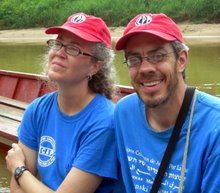
Monday, September 15, 2008

South America Log #13

Dear Friends and Family,

"Colombia: the only risk is wanting to stay." A billboard with these words greeted us at the Bogotá airport on a recent flight back from a vacation that ended in Quito, Ecuador. After two years in Colombia accompanying human rights workers and community organizers whose lives are very much at risk, we recognized that for many Colombians this slogan is hollow propaganda. At the same time, as we returned from a fantastic vacation that included visiting waterfalls, rivers and mountains of southern Colombia, we could partially identify with the message. Colombia is a beautiful country, and it will be hard for us to leave.

We are writing to you just 3 weeks before we move back to Minneapolis. You can imagine that our hearts and minds are full as we consider all we have learned and experienced in the past two years and we anticipate sad good-byes here and warm reunions in the United States. To sum up our experience, and pass time at the airport, we came up with the following lists:

What we will not miss about Colombia:

Military check points, common on roads and river ways. Usually all the men in the bus or boat are asked to leave the vehicle, show their ID cards, and get patted down.

Death threats to social organizations, including the 4 new threats received in August by organizations here in Barranca, all signed by the paramilitaries. Although we plan to continue to draw attention to these issues from the U.S.

The heat, although it did dip down below 80 degrees in our bedroom once, and we had a heavy breeze last week that everyone is still talking about.

The smell of the oil refinery that sends us to check for the hundredth time whether something in the house is actually on fire.

Meat- and starch-heavy meals.

Knee-deep mud.

Mosquitoes, chiggers, ticks, and all kinds of other biting insects we've encountered in the rural areas. The relatively innocuous dengue- and malaria-free mosquitoes of Minnesota will be a welcome change!

Dengue fever, fondly known as "break bone" fever by those who have experienced it.

Staying in touch with friends and family via email.


What we will miss about Colombia:

Tropical fruits; we are eating big bowls of fresh pineapple, papaya and mango each day just to store up for the long, apple-filled winter in Minnesota.

Travel by river, the best way to commute to meetings that we can think of!

Cooling nightly downpours during the rainy season.

Opportunities to experience and learn from another culture, although we still cannot figure out how to navigate the traffic. We have learned that the lights go from red to yellow to green, and that yellow can most easily be defined as "start your engines" and is not at all related to the "time to slow down" in the U.S.

Opportunities to learn Spanish, although we will not miss having to worry if a slightly mispronounced word might easily become a swear word, like the other day when Michele attempted to say the word for "bald" and a gracious listener kindly corrected the pronunciation and advised against the ill-spoken word. By the color in her friend's cheeks, Michele knew never to try to say "bald" again.

Things we will take with us:

The courage and commitment of our many partners, including the women's organization that boldly states, "It is better to live in fear than to stop living because of fear."

Living in a community that does not emphasize material possessions, capitalism or individual capital gain. Like the young barefoot boy that helped Michele with her backpack at a river port and then refused the offer of a few pesos, Michele thinking that he must be one of the many people at the port making their living by transporting goods.

A more profound understanding of our global connectedness and our impact on the lives and economies and communities of people living thousands of miles from us. We have seen how our choices in the U.S. can lead to deforestation, violence and displacement, or to sustainable development, secure communities and fairer employment.

The anticipation we feel thinking about our return home is mixed with the angst of job searching. Your job leads and job search hints are still welcome.

For photos of our recent vacation to southern Colombia and Ecuador see our photo album.

We've also particpated in a short video interview about the accompaniment work we've been doing. The video was created for the website of New Tactics in Human Rights, a web community of human rights workers created by The Center for Victims of Torture in Minneapolis.

To read more about CPT or make a donation in our name, go to www.cpt.org.

In Gratitude,

Michele and Nils

P.S. More stories about daily life in Colombia.

It was brought to our attention (thanks, Tony) that we omitted Flora and Fauna in our last update so here it is, along with a few other odds and ends.

Flora and Fauna: - With temperatures in the 80's to 100's all year around you can imagine that we enjoy beautiful flowering trees and plants all year as well, including the bougainvillea on our patio, and an amazing variety of heliconias. Colombia also has the most diversity of orchids in the world, with thousands of varieties. For the most spectacular tree we have seen, check out our Garzal photos from Christmas.

Our best fauna stories are already included in our Food section of the last email but we have met some animals we have not, yet, had the opportunity to eat. A favorite memory is when a falling monkey almost hit Nils. Nils was standing almost directly below a family of monkeys who were traveling in trees 70 feet tall. One particularly clumsy monkey hesitated and then leapt for a branch and missed, falling right towards Nils. Nils scrambled to get out of the way, but fortunately the monkey caught itself in a 15-foot tall cacao tree that was growing beneath the taller trees, and it quickly clambered back up to a higher perch. We're not sure who was more frightened, the monkey or Nils.

Other animals we have enjoyed are the mules that have transported us long distances to meetings. Sometimes this travel becomes quite treacherous due to roads covered in several feet of mud. One time Michele was on a two-hour mule trip with a teammate and the mule driver. Michele watched in surprise as the mule driver jumped off of his mule just as the mule lost its balance when one leg sunk into belly-deep mud. Thankfully, this lessened the surprise for Michele when her mule toppled over a few minutes later. Luckily, the soft mud that had caused the fall also created a nice pillow for Michele's leg that was now trapped under the mule. The mule driver reached Michele in record time, and with a few quick pushes the mule was back on its feet and Michele and her muddy pants got back up on the mule.

On our river trips we see hundreds of birds including egrets, herons, cormorants, ducks, and kingfishers, as well as a lot of birds we can't identify. When a birdwatcher, armed with her bird book joined our team she was thrilled to see dozens of birds she had never seen before, on her first trip on the river! Insects (the biting kind) were mentioned earlier in this letter, but Colombia also has an amazing variety of butterflies, and some really cool beetles.

We have also seen small crocodiles, iguanas as big as cats and twice as long, small lizards that can run across the surface of the water, and several small rodents that seem to not have names in English. When one teammate asked a farmer for the difference between a 'tiger', a 'lion' and a 'puma' (small wild cats that live in the region and are not the cats we know by this name), he responded, "A tiger is a tiger, and a lion is a lion, and a puma is a puma." We felt this summed it up pretty well.

Nils has added to his list of "strange foods" recently when he insisted on eating a guinea pig (cuy) for his birthday. It was so big that he was able to split it with a friend. Nils got the head since it was his birthday, and our friend got the butt. Michele took the tiniest bite possible that would still qualify for "I ate guinea pig".

"Mud" could have its own section. Like the time the roads were too muddy for a truck to provide transport and motorcycles were sent, in the rain, to collect Michele and a teammate. With a shrug and a "what can you do?" they put on their raincoats and each got on the back of a motorcycle. A short time later one of the motorcycles broke down and the trip ended with Michele, the teammate, the driver and a large back pack all on one motorcycle, in the pouring rain, arriving in town covered in mud and unrecognizable to people that knew us. Luckily, our driver shared our "what can you do?" attitude and when the rain picked up he chimed in saying, "Oh, nothing like a downpour to make everything fresher."

Thursday, September 11, 2008

Short video about our work

In January, our CPT Colombia team participated in a on-line dialogue about Unarmed Accompaniment on the New Tactics for Human Rights website. When the two of us were back in Minnesota in April, the folks for New Tactics asked us if we would be willing to be interviewed by them for a short video about Colombia and the use of accompaniment as a tactic to protect communities at risk of violence. Below is a nine-minute video they made, based on the interview with us.


Special thanks to our friends Tim and Kevin for the use of their lovely sunporch.

Take Action for Colombia

At the end of July, the State Department again certified that the Colombian military has been meeting the basic benchmarks set forth by Congress on respecting human rights and breaking ties to paramilitaries.

While progress has indeed been made in a few high-profile human rights cases, and some important arrests have been made, the sad truth is that the Colombian military continues to commit human rights abuses with near total impunity.

The Latin American Working Group (LAWG) is asking people to send a simple, but strong, message to the State Department - wrong decision, wrong time, wrong message.
Click here for an on-line form to take action and make sure your voice is heard!

A big human rights concern that we have seen in our work is extrajudicial killings by the Colombian military. We wrote in an earlier blog post about this phenomena, and The LA Times recently published an updated story on these illegal killings by the military which are common (329 last year), but rarely result in prosecutions, or even thorough investigations of the soldiers involved. There are also some photos on the CPT website from a recent accompaniment CPT did to support the investigation of one of these extrajudicial killings.

Sunday, September 7, 2008

Our recent trip to southern Colombia and Ecuador

In August there were a bunch of other people on team with us so we were able to take a two-week vacation to see a little more of Colombia (the south this time) and to visit Ecuador. See below for pictures.


We went to stay with our friend Karen that Michele met at a workshop last year, and and visited the Tatacoa desert near Neiva with her. Then we continued on to San Agustin, where archeologists have discovered hundreds of tombs and funerary sculptures dating from between 900 BC and 1200 AD. We continued on to Popayan, Pasto and Ipiales, and then crossed the border to Ecuador. We spent several days in Otavalo, Ecuador hiking and visiting the indigenous market, and then went on to spend a day in Quito and to visit a monument at the Equator, which runs just outside of Quito.

Sunday, June 29, 2008

Recent Accompaniments

Here are a few photos we have taken on recent accompaniments.

Recent accompaniments - June 2008

Photos of Barranca

Here are some photos of life in Barrancabermeja, our home for the last year and a half.

Barranca

Sunday, June 22, 2008

South America Log # 12

Dear Family and Friends and Assorted Peacemakers,

It took us a few months to notice the trend. Last September, the military arrested four leaders from a farmer's organization, and issued arrest warrants for 18 more of the organization's leaders. The leaders went into hiding, leaving the organization essentially dismantled. In January, armed men broke into the apartment of the director of a women's organization and threatened her life. She left Barrancabermeja for her own safety. In March the director of a local human rights organization moved his family to Bogotá for their safety. When we returned to Barranca in May, after 6 weeks of vacation in Minnesota, we learned that several development workers and priests from a rural area CPT accompanies had received written threats and had displaced from their communities.

As the media will report, and Colombian President Uribe and President Bush will boast, violence is down in Colombia. But, any human rights or development worker will tell you the threats continue, one by one, one by one. And, soon, numerous human rights workers are gone or threatened and the news media and global community hardly even noticed.

Sometimes the threat comes from the Colombian government itself. The government will arrest community leaders for "rebellion". Often the evidence is flimsy and the courts eventually release the person, but during their detention, the government has kept this person from organizing. Four of the leaders of the small farmers organization mentioned above were released after almost 6 months in prison when the government could not produce evidence against them. The leader of the small gold miners' organization was held for rebellion for over a week and then released for lack of evidence. An advocate for political prisoners was himself held for 18 months and then released before his trial date, again for lack of evidence.

When CPT first arrived in Barrancabermeja 7 years ago the physical violence of the conflict was evident. Our teammates attended funerals of people they had accompanied, they were present moments after people were killed, and they encountered dead bodies floating in the rivers where we frequently travel. Thankfully, it's been over a year since the physical violence of the conflict has touched our team that closely. The type of violence experienced by our partners has changed but the effects on human rights are not any less damaging.

So, the need for accompaniment continues in Barrancabermeja. This week Nils spent a day accompanying local elections in a nearby town where there are concerns that paramilitaries will intimidate people from voting. Michele spent 3 days with development workers who were leading a workshop on cooperative projects including buffalo and coffee.

Thank you to everyone who reads our writings, checks out our blog, takes action on an issue impacting Colombia, sends us an email, or donates to CPT in our name!

In hope,

Michele and Nils


You can read more about the tactics used against human rights workers in the Amnesty International report, Colombia: Fear and Intimidation: The dangers of human rights work.

To read about one aspect of economic oppression facing rural Colombians, Nils recently wrote a short essay on the likely impacts of the U.S. Free Trade Agreement with Colombia. Go to our blog (http://nilsandmichele.blogspot.com/) for a link to the article and to see photos of Barrancabermeja.

If you have read this far, you might be one of our friends who has asked to hear some more of the personal details of our life in Colombia. Here they are:

Spanish – Nils came to Colombia with a decent level of Spanish having spent one year of high school in Venezuela. I had taken lots of evening Spanish classes but felt stuck at the intermediate level. When I came to Colombia I had high hopes of becoming fluent. In our 18 months in Colombia, the work of CPT has taken precedence over Spanish learning and at times it has been more important to get the work done than to do the work in Spanish. Our co-workers are from Canada, the U.S. and Colombia and the Colombians want to practice English as much as I want to practice Spanish. So, some days meetings are in Spanish, some days in English. When we go out to visit communities, I almost always travel with a teammate with stronger Spanish than me.

With less than 4 months left here I have decided to spend some more focused time on Spanish learning. I will go to Medellín (about 8 hours away) in July for 3 weeks of language classes in the morning, volunteering at a school in the afternoon and living with a family. I hope the time of traveling on my own and relying on my Spanish will do a lot for my Spanish skills and my confidence in my Spanish.

Friends – It has been difficult to make friends here for several reasons. The culture in Barranca is very much centered on family, so time outside of work and on holidays is usually spent with family. People have said so many hellos and good-byes to CPTers that they often do not want to take the risk again to get close to one of us. We often feel the same way, having made friends again and again with other international accompaniers only to learn on our second or third meeting that they will be leaving Barranca. I (Michele) did make a friend about a year ago on an accompaniment. Gladis is a grade school teacher who has to learn English because her school is going bilingual. Gladis and I get together almost every week. I enjoy the time spent talking with her family, sharing a meal and practicing Spanish. When she pulls out her English textbooks I also get to review my irregular verbs and the difference between a past and present participle.

Free time – Barranca is an industrial, working class city of about 300,000 people that offers few cultural activities. We ride bikes, swim at a hotel pool, do laps at an Olympic sized pool, rent movies, go out for pizza, walk downtown for ice cream or a beer, play board games and go dancing if we can stay awake until 11pm when people start going out. Only once have we ventured out for a game of minitejo. It's similar to horseshoes except you throw a small metal disk or tejo across the court and if it lands in the center it will explode a small packet of gunpowder. When our group of foreigners finished playing, the court owner got a real laugh when he discovered we had only managed to finish one game in the 3 hours we were there.

Food – tropical fruits would best define the cuisine here, along with cassava, plantain, rice, meat or fish, and arepas (round, flat bread made from corn flour). The only tortillas are imported from the U.S. and food is never spicy. Fresh fruit juice of every variety is commonplace – we will miss the passion fruit juice the most! We were told once that you could eat a different fruit every day for a year in Colombia. We began to believe this when our 28-year-old Colombia housemate was asked the name of a fruit and he said he had never seen it before.

Strange foods – although we still both prefer to eat vegetarian food we quickly realized that would not be realistic here, especially when we travel in rural areas and much of the food is brought in from a long distance. We eat what is served to us. We have eaten turtle (not recommended), every internal organ of a cow (especially not recommended, intestines – they might look like pasta but do not be fooled!) and several large rodents (Nils thinks the ponche is good with coconut milk). We hope to travel to southern Colombia and Ecuador before we leave, which might mean trying guinea pig.

In turn, Colombians tell us that our strange (and detestable) foods include peanut butter, olives, pickles and cranberry juice.

Now, if you have read this far, you owe us an email, even a short one, to tell us what you are up to!!

Sunday, June 15, 2008

Free trade and small farmers

Recently Colombia has been in the news a lot in discussions about the proposed "free" trade agreement (FTA) being proposed between the U.S. and Colombia. I recently wrote a short article for CPT's e-mail list about the FTA and the effects it would have on small farmers. A lot of Colombians oppose the FTA, but in trying to write about it I've discovered that the issue is complicated - its easy for multinational companies to see how it benefits them, but it's hard for family farmers, factory workers, and ordinary citizens to understand the economic impacts it will have on them, and on the Colombian civil conflict. My article attempts to explain some of these impacts, without getting too technical.

Unfortunately, although the U.S. congress has refused to vote on the FTA this year, I'm pessimistic that this is more than a short-term victory. There was a great article recently in the Globe and Mail talking about a proposed Canadian FTA with Colombia, and how when that passes - now seen by most observers as almost assured - the U.S. will follow suit.

Sunday, June 8, 2008

Extrajudicial killings

The end of March, there were articles in both the Washington Post and the LA Times about Colombian civilians killed by the military. In our work here in the Middle Magdalena, we frequently hear about people, often civilians, who are killed by the Colombian military outside of combat. The LA Times article in particular, titled "Extrajudicial slayings on rise in Colombia", did a good job of describing the underlying incentives for these extrajudicial murders.


Sunday, May 25, 2008

118 days

Another book to recommend, although having to do with CPT, not Colombia. Christian Peacemaker Teams is publishing a book "118 Days: Christian Peacemaker Teams Held Hostage in Iraq", about the hostage crisis involving four CPTers in late 2005 and early 2006. The book includes reflections by the surviving hostages, but also talks about the experiences of CPT staff, friends and family who worked for their release while trying to maintain hope.

CPT is launching the book with a June 5th potluck in Chicago. See the 118 Days website for more information about the book.

Saturday, March 8, 2008

South America Log - No. 11

March 8, 2008

Greetings friends and family,

Happy International Women's Day! After receiving numerous worried emails about the crisis between Colombia and its bordering countries we decided to write about that situation. Our team in Barrancabermeja is a long ways from all of Colombia's borders, so there has never been direct danger related to these tensions to CPTers or to our partners here.

As of yesterday, March 7, we are thankful to report that tensions between Colombia and Venezuela and Ecuador have eased due to diplomatic conversations at the 10th annual Rio Summit of leaders of Latin American countries. The Rio Summit was scheduled prior to the events that sparked tensions between Colombia and its border nations. The agenda of the Rio Summit was quickly changed to focus on the crisis between these countries.

Here is a summary of events over the past week for those who have been trying to get a handle on the situation here:

On February 27, through negotiations facilitated by the government of Venezuela, there was another step forward in a peaceful end to the armed conflict when the guerrilla group the Revolutionary Armed Forces of Colombia (FARC) released four more of the approximately 700 hostages they have kidnapped and held for years. Three days later on March 1, Colombian governmental forces crossed into Ecuador and, through aerial bombardment and an on-ground military raid, killed a key FARC leader, 'Raúl Reyes', as well as twenty others identified in the press as FARC members. Some reports suggest this attack on a FARC base inside of Ecuador was aided by U.S. intelligence. According to Ecuadorian President Rafael Correa, at the time of his death Reyes was in negotiations with the Ecuadorian government regarding a further release of hostages.

On March 2 Ecuador and Venezuela withdrew their ambassadors from Colombia and both countries moved troops and tanks to their borders with Colombia. On March 6 Nicaragua also withdrew its ambassadors from Colombia. On March 7 at the Rio Summit the four countries reached a diplomatic agreement to this conflict.

We recommend Adam Isaacson's blog at the Center for International Policy www.cipcol.org for ongoing concise analysis of events in Colombia, and links to recommended news sources.

*******

In celebration of International Women's Day, the Women's Popular Organization (OFP) hung posters throughout Barrancabermeja opposing the armed conflict. They asked CPT if we would spend time at each of their community centers, as they were concerned about reprisals for the hanging of the posters. Yesterday we went out in pairs to eat lunch at the soup kitchens operated at each of the OFP's community centers. As Nils and I enjoyed our lunch of soup, rice and beans, salad, plantains and fresh lemonade, everyone in the dining room sat silently watching the television news. The media was announcing that the Colombian Army had killed 'Iván Ríos', another member of the FARC's seven-person secretariat or leadership council. The murder the week before of 'Raúl Reyes' was the first death of a FARC secretariat member in their almost 50-year existence.

As I listened to the news of 'Iván Ríos' death, I felt sad to realize that many people will hear the news of the death of two FARC leaders as proof that a military solution to the armed conflict is working. Thankfully, there are also many people who believe non-violent responses and a negotiated solution to the armed conflict is not only possible but necessary. Near our lunch table at the soup kitchen was one of the posters created in celebration of International Women's Day with the slogan, "We do not want a peace that oppresses or a war that kills." The killing of the FARC leaders by the Colombian Army is certainly, "the peace that oppresses." The hanging of these posters is just one of the many courageous acts of resistance to this war that we witness every day.

International Women's Day will be a more somber one for the OFP this year as it will be the first celebration they have held in 30 years without their President, Yolanda Becerra, in attendance. Ms. Becerra was assaulted in her home the night of November 4, 2007 and members of her family have been harassed and threatened. Ms. Becerra has left the city but the women of OFP are as determined as ever to work for women's rights.

In other news, Michele recently returned to Garzal, the community where we spent Christmas. We are organizing a delegation of 11 Colombians to visit Garzal next week to see first hand their struggle for land titles.

Nils recently spent 4 days with the mining community in meetings to hold the Colombian government accountable to agreements they made after the Army killed mining leader, Alejandro Uribe in September 2006.


We also enjoyed two weeks at the Caribbean Coast in February, where highlights included a visit to where the desert meets the ocean in the northernmost tip of Colombia and a morning spent scuba diving. You can see photos of our vacation below in this blog.


We will be back in Minnesota from March 26 to May 6. Then we will return to Colombia where we plan to stay until September 2008.


In Peace,

Michele and Nils


To learn more about the work of CPT or to make a donation in our names please visit www.cpt.org

CPT MISSION STATEMENT: Christian Peacemaker Teams (CPT) Colombia is a
community made up of trained volunteers from different cultures that forms part of the international, ecumenical organization, CPT. Our work is based in, though not limited to, the Middle Magdalena region of Colombia. We work together on grassroots initiatives to expose and transform structures of domination and oppression through active nonviolence in order to make possible a world grounded in respect, justice and love, even of enemies.

Our trip to the Caribbean

Hi everybody,

We're back form two weeks of relaxing along Colombia's Caribbean coast. It was great. Here are some photos from our trip.

Caribbean Coast Feb 2008

Women's Mobilization in Nariño

Last November when Nils was in Nariño he got to attend an amazing women's march for Peace, bringing together over 4,000 women from all over the country. (He also got to travel 30 hours across Colombia with 40 exultant but sleep-deprived women returning from the march.) Here are some photos of the march that I should have posted a long time ago.

National Women's Mobilization

Sunday, December 30, 2007

South America Log - No. 10

Dear Friends and Family,

We are back from our trip to Garzal where we enjoyed experiencing a rural Christmas. Click the picture below to see some of our photos from the trip:

Garzal
We were relieved that it was a quiet week given the communities concerns about increased violence during the holidays. Since we have only recently started working with this community, we spent much of our time visiting families to introduce ourselves and CPT, and to learn a little about their life and experiences.

We found many of the Christmas traditions to be familiar. Families were enjoying out of town guests. A common meal was prepared and shared by many families before going to Christmas Eve church services. Some families gave small gifts to their children. We enjoyed special foods that are usually only prepared at Christmas, including tamales and a spice cake baked over a wood fire. And, some in the community celebrated with drinking beer all through the night and into the next day.

A memorable part of our stay in Garzal was the Christmas Eve vigil at a small evangelical church in the community. (The pastor’s family was our main host for the week so our decision about whether to spend Christmas Eve with the church-goers or beer drinkers was clear.) The pastor, perhaps running short on music to keep the 4-hour vigil going until midnight asked us if we would sing a song. We agreed and sang ‘Joy to the World’ and ‘Silent Night’, explaining that in many churches in the US on Christmas Eve, the lights are extinguished and Silent Night is sung by candlelight. The pastor decided to end their vigil in the same way, so they passed out candles, turned off the generator, and we all sang ‘Noche de Paz’ at midnight. It made us both a little teary to enjoy a tradition from home and to think of many of you singing the same song that night.

We also enjoyed swimming in the Magdalena River, which is the color of chocolate milk, with our host’s family. And, on our last night with the family, we sat around joking and singing before going to bed. They asked us to sing for them and said they would sing for us in return. We sang Jingle Bells and then taught them the chorus. Several people caught on quite quickly while some of the grandchildren got the tune but used the typical “shwah, shwah” sounds to imitate the English words. I imagine we will still be hearing the grandchildren sing “Jingle shwah, Jingle shwah, Jingle shwah, shwah, shwah” to the tune of Jingle Bells when we return to their home.

While this Christmas was free from violence for the people of Garzal, our many conversations with families reminded us that the threats they are facing continue to be very real. Although many have farmed the land for 40 years, they are in the midst of a 6-year-long struggle to gain titles to their land, titles they have a right to under Colombian law. In the past few months the struggle has intensified with increased pressure from illegal armed groups for the families to abandon their farms. Fortunately, more human rights workers and a lawyer have joined with the community to work on their behalf. As we listened to the worry of so many farmers about the possibility of losing their land and their livelihood we were reminded of the words of a Colombian mother we met on our first visit to Colombia. She described peace as “going to bed at night with a roof over your head, food for your family, and freedom from fear”. We pray that 2008 will be the year the families of Garzal receive the titles to their land, and we all can rejoice with them in being just a little closer to Peace on Earth.

May you and your community have a roof over your head, food for your family and freedom from fear in 2008.

In Peace,

Michele and Nils

Bonus Christmas Song -

People who live in rural communities have access to an abundance of fresh food and are happy to share, but by the end of our time we were beginning to feel like we were in a food-themed ‘Twelve Days of Christmas’, which inspired the following:

Seven Days of Christmas in Garzal:

On the seventh day in Garzal, a neighbor gave to me

Seven cups of coffee

Six coconuts

Five kilos of oranges

Four cups of tamarind pulp

Three sour guavas

Two ripe bananas

And a chicken tamale wrapped in banana leaves!


CPT MISSION STATEMENT: Christian Peacemaker Teams (CPT) Colombia is a
community made up of trained volunteers from different cultures that forms part of the international, ecumenical organization, CPT. Our work is based in, though not limited to, the Middle Magdalena region of Colombia. We work together on grassroots initiatives to expose and transform structures of domination and oppression through active nonviolence in order to make possible a world grounded in respect, justice and love, even of enemies.

Read more or make a donation at www.cpt.org.

Wednesday, December 19, 2007

South America Log - No. 9

December 19, 2007

Dear Family and Friends:

The season of Advent is one of anticipation, as we look forward to celebrations together with family, and think about our hopes for the coming New Year. This year in Barrancabermeja we also wait in anticipation, or perhaps trepidation, for news from the community of Garzal. This pastoral farming community along the banks of the Magdalena River is named for the many herons and egrets (“garzas” in Spanish) that populate the riverbanks. There’s no electricity or running water in Garzal, but there’s a strong sense of community among the 136 families that live there; many of them have farmed this same land for 40 years.

The peaceful life of the families in Garzal is under threat. The community has been engaged in a decade-long bureaucratic process to register the titles to their land; they are legally entitled to the land under Colombian law due to their long residence. In recent years, members of the illegal paramilitaries have tried to take control of the land for drug trafficking or cattle-ranching. Most recently they have threatened to evict the community or make them sign over their land titles, by armed force if necessary. The community is particularly worried about the holiday season; they feel more alone over the Christmas and New Year's holiday when many government and human rights offices will be on vacation, allowing the illegal armed groups to move through their communities with few repercussions.

Michele and our teammate Rachel recently spent two days with the residents of Garzal as they met with Colombian government, United Nations and human rights organizations to develop a plan to fight for their land rights and to ask the government to fulfill their obligation to prevent displacement. As one leader of the community stated, “A farmer without land is like a fish without water.”

Displacement is not a new problem in Colombia or in the world. Displacement has been going on for decades in the area surrounding Barrancabermeja, and a recent report by the government Human Rights Defender's office indicates that displacement in the region has increased by 89% in the last year.

2000 years ago, after Jesus’ birth, instead of returning home, Mary and Joseph were forced to flee to Egypt with their newborn son:

When they had gone, an angel of the Lord appeared to Joseph in a dream. "Get up," he said, "take the child and his mother and escape to Egypt. Stay there until I tell you, for Herod is going to search for the child to kill him." So he got up, took the child and his mother during the night and left for Egypt. (Matthew 2: 13-14)

Joseph, Mary and Jesus knew what it was like to live as displaced people, fleeing violence and leaving behind their family, friends, jobs and possessions in order to start a new life in a strange place that, hopefully, would offer safety. This experience of being displaced by violence is one shared by more than three million Colombians. Our hope is that the families of Garzal can avoid this fate and continue to farm the land they have peacefully lived on for generations.

This Christmas the two of us will experience a glimpse of the rural lifestyle that the families of Garzal are fighting for. In a few days, we will load up our backpacks and travel three hours by boat to Garzal to spend a week with the community. Unfortunately, we won't be able to call or respond to e-mails in the days around Christmas, although we will be in daily cell phone contact with our teammates. However, we are always glad when we get the opportunity to work together, and by the warm reception we've received in the past in Garzal, we are confident that spending Christmas with the families there will be a rich experience.

This Advent season please keep the people of Garzal in your prayers as they attempt to hold on to their homes and livelihood. And, may we all find small ways to build peace in our homes, communities and the world in the coming year.

Love and Peace,

Nils and Michele

P.S. We’ve put some more photos up on our blog – dancing salsa with our teammates, as well as pictures from our vacation to San Gil in November. Check them out at http://nilsandmichele.blogspot.com/

Tuesday, December 18, 2007

Salsa dancing!

I (Nils) am back from Nariño. My stay there ended up being just three weeks, but I had to turn right around for another five-day accompaniment almost as soon as I arrived back here. Now at last Michele and I have been able to spend some time together.

Click on the photo below for some pictures from a recent evening of dancing with some of our teammates at Las Cotorras, a favorite salsa bar. It was a supremely fun night, and a reminder that we need to get out more and enjoy Barrancabermeja’s nightlife.

Salsa Dancing

Monday, November 12, 2007

Update from Nils

Michele and I are spending a few weeks apart as I take part in an accompaniment in Nariño, in the far southwestern corner of Colombia, 30 hours from Barrancabermeja by bus. Nariño is beautiful, it’s very mountainous and also has a lot of rainforests. Right now I’m in Pasto, the capitol of Nariño, but we’ll mostly be working in the town of Ricaurte, about four hours from here. The newspaper ‘Diario del Sur’ has a bunch of photos of Ricuarte on their website (click here).

The photos do a pretty good job of telling the story of Ricaurte: beautiful mountainous rainforests, and lots of soldiers.

We’ll be in Ricaurte to accompany a community of Awá indigenous people that have been suffering in the armed conflict recently. Hundreds of families have had to flee their homes due to ongoing battles between the army and the FARC guerrilla, and many civilians have been killed, either caught in the crossfire or killed by landmines, which are prevalent in the rural areas. My teammate and I are not going to be visiting the rural areas for our own safety, but our accompaniment from Ricaurte can be helpful to the community leadership as they go about their work. We’re also hoping to write some articles to make the struggles of the Awá people more visible. I was here in Nariño last year in November, and it feels good to be back doing this valuable work.

Vacation in San Gil

We recently took a few days off team for a 4-day vacation in and near San Gil. Nils is leaving for an accompaniment in Nariño (the far southwestern corner of Colombia) so we wanted a vacation together before he left. San Gil is about 5 hours away from Barranca by bus, and the area around there is known for it's natural beauty, and it's beautiful colonial towns, as well as being a center for extreme sports such as whitewater rafting, hang gliding, and spelunking. We didn't do any extreme sports, but we did have a nice getaway, and went on some great hikes together.

In addition to San Gil, we visited the nearby village of Barichara, a beautifully-preserved colonial town. From there we hiked to a waterfall and to Guané, an even smaller village. Here are some pictures from our trip:

San Gil

Saturday, October 13, 2007

Video about Small Miners on the web

The British non-profit organization War on Want has produced a short video about mining issues in southern Bolivar province in Colombia. This area is close to Barranacabermeja, and we do a lot of work in the region, including accompanying the miners federation mentioned in the video. Michele and I have met José Uribe, the man interviewed in the film, several times, and accompanied him at times when he felt his life was under threat.

The film does a good job of underlining the issues the small-scale miners are dealing with in the face of development interest by multinational mining companies.
Click here for the video.
It's worth watching.

Friday, October 12, 2007

South America Log - No. 8

Greetings Friends and Family,

After spending two months on vacation and giving presentations about Colombia in Minneapolis, we are writing once again from Barrancabermeja, Colombia. We returned to Barrancabermeja in September and we are excited to be spending another year here working with Christian Peacemaker Teams. (Your memory does serve you correctly if you thought we would only be here another 6 months – we made the decision over the summer to return for another year.)

We arrived to the news that the Colombian Army had begun a campaign of forced recruitment of young men to serve in the Army. Men are required to serve one year in the armed services unless they meet various conditions including being a student or caring for elderly parents. Legally, the Colombian Army can notify a young man that he is not in compliance with the law and order him to appear for his service. Instead, the Army has been driving around neighborhoods in a truck conducting sweeps, stopping every young man in sight and hauling him into the army base if he is not carrying a card verifying his military service.

One afternoon our teammate Pierre was walking when he saw two soldiers pointing at a young man on the sidewalk saying, "get that one there.". Coincidentally, Pierre knew the man, "Rafael", who is the 24-year-old leader of the local conscientious objector movement. Before being taken away, Rafael gave his cell phone number to Pierre and Pierre kept in contact with Rafael while he was detained. Rafael and the men detained with him were some of the lucky ones hauled off the street that day. As a conscientious objector, Rafael knows his rights regarding military service and he educated the other young men who were being detained with him. The Army realized they were worse off with Rafael in their detention area and they let him go the same day. But not before he had educated the other men that they had the right to refuse to sign any paperwork that day. The Army was unable to forcibly recruit anyone in Rafael's group.

A few days later Pierre and Michele met with the sergeant in charge of recruitment to express concerns about men being held, sometimes for days, without notification of their families and without the ability to fulfill work and family obligations. The sergeant admitted, "yes, it is irregular”, which is the official way to acknowledge that a practice violates their own standards without calling it “illegal” which would allow for action against them.

A recent CPT delegation from North America decided to design a public action to educate youth in Barranca about their rights regarding military service. The delegates constructed a large cardboard Army truck and painted it with the words, "NO to recruitment for the war, YES to recruitment for life."

The delegation and their Army truck walked through downtown Barranca passing out pamphlets notifying people of their rights under the recruitment laws. When they stopped in front of the Army battalion they enacted a scene of a person being forcibly recruited who then breaks away from the military to join a joyous celebration of life. Needless to say, this activity brought many soldiers out to the gate and the Commander watched for a few minutes before sending a soldier to get a video camera.

Rafael was with us that day and turned his head at first to avoid being filmed but then resumed his participation with his usual resolve to act on his convictions despite the potential consequences. For Rafael, who is an openly gay, conscientious objector in a city where paramilitaries regularly practice social cleansing by killing anyone they decide does not fit their ideal citizen, Rafael's every move is one of resolve. Instead of hiding in fear after the paramilitaries recently published a death list of young people involved in social movements, Rafael's participation in our recent public action conveys his unwavering determination.

When we gathered after the public action to share our thoughts and feelings about the day's activities Rafael was part of our circle. He tearfully talked about his need to continue to work for peace in honor of his many friends who have been killed in this 40 year old conflict. When we expressed concern that Rafael may be at greater risk now that the Army videotaped him, he told us not to worry and said, "when we do things from our heart then good things will come from them."

There is a saying here, "It is better to live in fear than to stop living because of fear." Every day Rafael and all Colombian peacemakers courageously choose to live and we are so honored to be able to continue for another year to share in peacemaking with them.

In Peace,

Michele and Nils

P.S. Four times per year delegations come to Colombia from North America to spend two weeks learning about the history and politics of Colombia, getting to know numerous human rights and peace organizations and visiting one of the rural areas where CPT works. To learn about future delegations go to www.cpt.org and click on “Delegations” on the left side of the page. We would love to host you and show you our work!