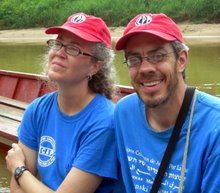
After a fairly uneventful return trip, Michele and I are back in Minnesota. So far we've only been here a few days, but it's been great to see family and friends again and cathc up on what we've been missing out on. I hope we'll have a chance to see many of you before we return to Colombia in early September.
We're staying with Michele's parents until the end of July. The phone number here is (651) 633-4451. As of August 1st we'll be back in our house in Minneapolis, and back at our old phone number - (612) 822-6653.
We've arranged a number of presentations over the next few months to show our photos and talk about Colombia. Please let us know if you'd like to come to one and we can make sure you receive an invitation.
We're also still looking for a renter. If you know anyone who needs a short-term (probably September through March), furnished rental in Minneapolis, please have them call us or e-mail us (my address is nilsdybvig(at)yahoo.com)
Wednesday, July 18, 2007


Wednesday, June 20, 2007
Books about Colombia
A while ago my Dad was asking me about a book on Colombia, and I (Nils) realized that he might not be the only one interested in reading about Colombia. Here are some books about Colombia I've read or had recommended to me; if you have other suggestions let me know.
NONFICTION:
More Terrible than Death: Massacres, Drugs, and America's War in Colombia by Robin Kirk.
A good overview of the Colombian conflict, but because the focus is on political violence, I think it makes the conflict in Colombia seem more intensely violent than it really is. Mom, please don't read this book.
The Profits of Extermination: Big Mining in Colombia by Francisco Ramirez Cuellar.
Michele is reading this book, which uncovers the way foreign corporations have manipulated the law and worked hand in hand with right-wing death squads and the US and Colombian government to ensure profits at the cost of the rights and lives of workers, peasants and miners. Ramirez Cuellar is president of the Colombian mining union Sintraminercol, and has been a speaker for CPT past delegations.
This book is especially relevant to CPT's work in the Sur de Bolivar, where small-scale gold miners are being pressured to displace from their land at the same time that multinational mining companies are moving into the region.
Killing Pablo: the Hunt for Pablo Escobar by Mark Bowden.
This book charts the rise and fall of Colombian drugs baron Pablo Escobar, exposing the massive operation by covert US Special Forces and intelligence services to hunt down and assassinate him in 1993.
The Open Veins of Latin America: five centuries of the Pillage of a Continent by Eduardo Galeano
I am currently reading this analysis of the effects and causes of capitalist underdevelopment in Latin America. It was written in 1973, so it's a little dated, but Galeano is an engaging writer and an excellent analyst, and the dynamics of underdevelopment he describes are even more evident today. He's written some more recent books too, such as Upside Down (2001).
FICTION:
One Hundred Years of Solitude by Gabriel Garcia Marquez
Colombian writer Gabriel Garcia Marquez is considered one of this century's greatest authors (he was awarded the Nobel Prize for literature in 1982), and this tale of life in a small Colombian town is seen as his greatest work. How can you go wrong?
The Dark Bride by Laura Restrepo
Restrepo is one of Colombia's most acclaimed contemporary writers, and this book is set in the oilfields and slums of a fictional town modeled on Barrancabermeja, where we're living this year. I loved this one, and her other books are also supposed to be excellent.
Read one. Read them all. Propose them to your book club. Happy reading!
NONFICTION:
More Terrible than Death: Massacres, Drugs, and America's War in Colombia by Robin Kirk.
A good overview of the Colombian conflict, but because the focus is on political violence, I think it makes the conflict in Colombia seem more intensely violent than it really is. Mom, please don't read this book.
The Profits of Extermination: Big Mining in Colombia by Francisco Ramirez Cuellar.
Michele is reading this book, which uncovers the way foreign corporations have manipulated the law and worked hand in hand with right-wing death squads and the US and Colombian government to ensure profits at the cost of the rights and lives of workers, peasants and miners. Ramirez Cuellar is president of the Colombian mining union Sintraminercol, and has been a speaker for CPT past delegations.
This book is especially relevant to CPT's work in the Sur de Bolivar, where small-scale gold miners are being pressured to displace from their land at the same time that multinational mining companies are moving into the region.
Killing Pablo: the Hunt for Pablo Escobar by Mark Bowden.
This book charts the rise and fall of Colombian drugs baron Pablo Escobar, exposing the massive operation by covert US Special Forces and intelligence services to hunt down and assassinate him in 1993.
The Open Veins of Latin America: five centuries of the Pillage of a Continent by Eduardo Galeano
I am currently reading this analysis of the effects and causes of capitalist underdevelopment in Latin America. It was written in 1973, so it's a little dated, but Galeano is an engaging writer and an excellent analyst, and the dynamics of underdevelopment he describes are even more evident today. He's written some more recent books too, such as Upside Down (2001).
FICTION:
One Hundred Years of Solitude by Gabriel Garcia Marquez
Colombian writer Gabriel Garcia Marquez is considered one of this century's greatest authors (he was awarded the Nobel Prize for literature in 1982), and this tale of life in a small Colombian town is seen as his greatest work. How can you go wrong?
The Dark Bride by Laura Restrepo
Restrepo is one of Colombia's most acclaimed contemporary writers, and this book is set in the oilfields and slums of a fictional town modeled on Barrancabermeja, where we're living this year. I loved this one, and her other books are also supposed to be excellent.
Read one. Read them all. Propose them to your book club. Happy reading!
Saturday, June 16, 2007
South America Log - No. 7
Dear friends and family,
We are just finishing up a 10 day trip visiting the Peace Sanctuary Churches we got to know when we first visited Colombia with a delegation in February 2006. The pastors of all 3 churches have also been guests in our home in Minneapolis so it's been a real blessing to get to connect again. Who could have guessed all the turns our life would take since that trip just 16 months ago.
We arrived in the first peace community after spending 13 hours traveling by bus from Barrancabermeja. Our hosts wanted us to visit one of their new development projects. We went by bicycle taxi to a small farm on the edge of town where several families are collectively raising chickens. We sat talking with a small group under a thatched roof porch as we waited for our lunch to finishing cooking over a small fire.
The talk made the usual twists and turns from weather and farming to politics, and specifically, US foreign policy in Colombia. Just two days earlier in the US House of Representatives, the foreign aid appropriations subcommittee had proposed a new approach to Bush's Plan Colombia by requesting a decrease in military aid to Colombia and an increase in development spending. The increased development aid will help the victims of the conflict, strengthen the judicial system, invest in rural development, and help farmers turn away from growing coca, the raw material for cocaine. We were surprised to discover that these small farmers in rural Colombia had already heard this news about a possible change in funding and they were feeling very encouraged.
This was the first of many similar conversations as we continued our trip. And, each time, the Colombians already knew of the proposed changes to Plan Colombia. Just maybe, we told each other, the advocacy we have been doing together is working.
These peace churches know the realities of the armed conflict in Colombia. One congregation was started by hundreds of families who were forced to flee their farms after the violence towards them became too great. Each church has members who have been disappeared or killed. The pastors themselves have been threatened. Just last year one of our hosts received a series of phone calls from an armed group demanding money and threatening him and his young family. His church responded with a round-the-clock vigil at his house until the threats subsided. In the midst of these realities these churches have resolutely proclaimed themselves peace sanctuaries and rejected any use of violence to end the conflict. Instead they have promoted economic development for their communities, alternatives to military service, and negotiated solutions in an effort to end the conflict.
After we said good-bye to one of our hosts we drove out of their town of 12,000 people in a taxi. Five army tanks and 15 soldiers lined the road. How, we wondered, will these tanks bring peace to this small farming community?
These conversations are a stark reminder of the direct impact that decisions made in Washington, DC are having on the people of Colombia, and the ongoing need to bring their stories back to the United States.
We are buoyed by the news from Washington that Plan Colombia may be facing significant changes. Still, there is much more work to do. A Free Trade Agreement with Colombia is still up for debate and all of our Colombian associates suggest that while this agreement will benefit the large landowners and big business of the US and Colombia, it will further worsen the economic crisis facing the majority of poor Colombians. This economic crisis fuels the conflict as young men join the illegal armed groups for lack of other economic opportunities, and farmers grow coca because the prices they receive for other crops won't support their families. Also, while positive changes to Plan Colombia have been proposed in the House, there is still a lot of work to do before the proposal becomes law. The full House is expected to vote on the foreign aid bill some time next week, so your calls to congress are needed. Visit http://www.lawg.org/countries/colombia/alert_06-07-07.htm for more information on how to call your congressperson and what to say.
Within our team in Barrancabermeja we still have much to learn and, we hope, more to contribute. For this, and so many reasons, we have decided to return to Colombia for another 6 months after spending the summer in Minneapolis. The most difficult part of this decision will be living far from friends and family for 6 more months, but it's the very support and encouragement we have received from so many of you that make it possible to return to Colombia.
We hope to see many of you this summer in Minneapolis. We also hope to arrange some presentations so please let us know if you have a group that is interested. After July 11 we can be reached at Michele's parents at 651-633-4451. The month of August we expect to be back at our house with our former phone number, 612-822-6653.
Finally, we have a house to rent! If you know anyone who needs a short-term (probably September through March), furnished rental in Minneapolis, please pass on our email addresses to them.
In Peace,
Michele and Nils
We are just finishing up a 10 day trip visiting the Peace Sanctuary Churches we got to know when we first visited Colombia with a delegation in February 2006. The pastors of all 3 churches have also been guests in our home in Minneapolis so it's been a real blessing to get to connect again. Who could have guessed all the turns our life would take since that trip just 16 months ago.
We arrived in the first peace community after spending 13 hours traveling by bus from Barrancabermeja. Our hosts wanted us to visit one of their new development projects. We went by bicycle taxi to a small farm on the edge of town where several families are collectively raising chickens. We sat talking with a small group under a thatched roof porch as we waited for our lunch to finishing cooking over a small fire.
The talk made the usual twists and turns from weather and farming to politics, and specifically, US foreign policy in Colombia. Just two days earlier in the US House of Representatives, the foreign aid appropriations subcommittee had proposed a new approach to Bush's Plan Colombia by requesting a decrease in military aid to Colombia and an increase in development spending. The increased development aid will help the victims of the conflict, strengthen the judicial system, invest in rural development, and help farmers turn away from growing coca, the raw material for cocaine. We were surprised to discover that these small farmers in rural Colombia had already heard this news about a possible change in funding and they were feeling very encouraged.
This was the first of many similar conversations as we continued our trip. And, each time, the Colombians already knew of the proposed changes to Plan Colombia. Just maybe, we told each other, the advocacy we have been doing together is working.
These peace churches know the realities of the armed conflict in Colombia. One congregation was started by hundreds of families who were forced to flee their farms after the violence towards them became too great. Each church has members who have been disappeared or killed. The pastors themselves have been threatened. Just last year one of our hosts received a series of phone calls from an armed group demanding money and threatening him and his young family. His church responded with a round-the-clock vigil at his house until the threats subsided. In the midst of these realities these churches have resolutely proclaimed themselves peace sanctuaries and rejected any use of violence to end the conflict. Instead they have promoted economic development for their communities, alternatives to military service, and negotiated solutions in an effort to end the conflict.
After we said good-bye to one of our hosts we drove out of their town of 12,000 people in a taxi. Five army tanks and 15 soldiers lined the road. How, we wondered, will these tanks bring peace to this small farming community?
These conversations are a stark reminder of the direct impact that decisions made in Washington, DC are having on the people of Colombia, and the ongoing need to bring their stories back to the United States.
We are buoyed by the news from Washington that Plan Colombia may be facing significant changes. Still, there is much more work to do. A Free Trade Agreement with Colombia is still up for debate and all of our Colombian associates suggest that while this agreement will benefit the large landowners and big business of the US and Colombia, it will further worsen the economic crisis facing the majority of poor Colombians. This economic crisis fuels the conflict as young men join the illegal armed groups for lack of other economic opportunities, and farmers grow coca because the prices they receive for other crops won't support their families. Also, while positive changes to Plan Colombia have been proposed in the House, there is still a lot of work to do before the proposal becomes law. The full House is expected to vote on the foreign aid bill some time next week, so your calls to congress are needed. Visit http://www.lawg.org/countries/colombia/alert_06-07-07.htm for more information on how to call your congressperson and what to say.
Within our team in Barrancabermeja we still have much to learn and, we hope, more to contribute. For this, and so many reasons, we have decided to return to Colombia for another 6 months after spending the summer in Minneapolis. The most difficult part of this decision will be living far from friends and family for 6 more months, but it's the very support and encouragement we have received from so many of you that make it possible to return to Colombia.
We hope to see many of you this summer in Minneapolis. We also hope to arrange some presentations so please let us know if you have a group that is interested. After July 11 we can be reached at Michele's parents at 651-633-4451. The month of August we expect to be back at our house with our former phone number, 612-822-6653.
Finally, we have a house to rent! If you know anyone who needs a short-term (probably September through March), furnished rental in Minneapolis, please pass on our email addresses to them.
In Peace,
Michele and Nils
Wednesday, May 16, 2007
Trip to Chile, April 2007
In April we spent two weeks visiting Santiago and Southern Chile with our neighbors from Minneapolis, Lisa, who is on a sabbatical with her family, Sergio and Camilo.
 |
| Chile, April 2007 |
Sunday, April 22, 2007
South America Log - No. 6
Greetings Friends and Family:
First, the good news: In our last newsletter we spoke about the disappearance of Katherine Gonzalez Torres. We rejoice that Katherine has been returned to her family, physically unhurt.
The other good news is that we leave in a few hours for a two-week vacation in Chile. Our friend and neighbor in Minneapolis, Lisa, has been on a sabbatical this past year with her partner's family in southern Chile. We are looking forward to seeing friends, exploring the ocean and mountains and drinking red wine.
Earlier this month we went together on an 11 day accompaniment to a small town called Mina Caribe in the Sur de Bolivar mining zone. To get to Mina Caribe, we took a bus for three hours, then a taxi, then traveled an hour by boat, then another taxi, then two hours by four-wheel-drive truck, and finally three more hours by mule. We accompanied a five-day leadership training school put on by the Sur de Bolivar Agro-Miners Federation, and then we stayed on in Mina Caribe for the Federation's General Assembly, which was attended by 100 miners and farmers representing 24 local associations. Participants were welcomed to the Assembly by a banner proclaiming, "Welcome Agro-mining Communities in Resistance." Unfortunately, just meeting for this lawful assembly became an act of resistance.
As the first miners began to gather for the assembly, 7 soldiers and their sergeant walked into town. The presence of the Army immediately increased the tension in the community. The Military has had an ongoing presence in the area for only the last year, so they know very little about the communities, and are suspicious of almost everyone. Detentions of community members are common and last September Alejandro Uribe, a mining federation leader, was killed by members of the Nueva Grenada battalion, the same battalion that was now occupying the town square. Community leaders fear that the army's harassment is part of a larger government strategy to remove them from their land so that foreign mining companies can take over the gold mining in the
region.
The Government Human Rights Ombudswoman had already arrived, anticipating interference by the military. The Ombudswoman and Michele and I introduced ourselves to the Sergeant and reminded him that military presence in civilian spaces is in direct violation to the Geneva Convention. The Sergeant defended his role there, saying his troops needed to protect the people. He repeatedly asked for the names of the event leadership. The Ombudswoman left to telephone the battalion's commanding officer to ask for the soldiers to be recalled.
One of the men with the Sergeant was a former resident of the town who was forced to move after being caught stealing. He is a civilian but he was dressed in an army uniform and carried a weapon that appeared to be a grenade launcher. He began to point out various members of the town, possibly to mark them as guerrilla supporters. Townspeople gathered around to denounce the use of the informant, calling him "the robber" and questioning his reliability.
Two hours after the soldiers arrived, several leaders assembled the community and asked us and other organizations accompanying the assembly to meet with the Sergeant and ask him to remove the informant from town. When the sergeant was called into the town square, he reported that in response to our phone calls his superiors had recalled his unit, and he angrily accused the residents of working behind his back. The Ombudswoman said she had requested his removal and that the Federation is a legally recognized organization holding legally sanctioned events. Several community members spoke up in protest of the use of the informant. Before the Sergeant left with his soldiers he took Michele and my names and identification numbers, as well as those of the other national and international accompaniers.
Shortly after the soldiers left, the miners began their Assembly, refusing to be deterred in their mission "For the right to a dignified life and permanence on the land."
Most of our time in Mina Caribe was quiet an uneventful, and I found myself feeling unnecessary. I found myself thinking "I wish I could be doing something more helpful." Then suddenly the military showed up, we were suddenly working at full-speed, and I found myself thinking, "I wish our help wasn't needed."
Given our experiences with human rights abuses by the Colombian military we were dismayed recently when Secretary of State Condoleezza Rice certified that Colombia had met the Human Rights criteria required for the release of $55 million in U.S. military aid. We were grateful when, a few days later, Senator Patrick Leahy, the chair of the Foreign Operations subcommittee of the Senate Appropriations Committee, put a hold on the aid until the Senate could conduct its own Human Rights investigation. As we witness intimidation of community leaders by the military we are aware that as U.S. citizens we bear the responsibility for some of this problem since our government continues to fund the Colombian military at an alarming rate. In total, U.S. aid to Colombia was more than $700 million this year, over 80% of which goes to Colombian security forces. We are hopeful that ongoing pressure by human rights organizations and the organizing being done by CPT and other groups will continue to lead to
positive change in U.S. foreign policy towards Colombia. As we have been told many times by our Colombian partners, "more war will not give us less war."
Our friends often apologize in their e-mails, saying their lives sound boring in comparison to our monthly logs, but when they do write, their messages always fill me with hope: life continues on, people struggle with large and petty things, they play with their kids, they're sad and they're happy, they are OK. If my faith is what helps me do this work, more than anything it's my faith that life continues on like this.
Peace and Be Well,
Nils and Michele
P.S. Most of this log comes from an article we wrote for CPTnet. You can view both articles we wrote about our trip to Mina Caribe on our blog http://nilsandmichele.blogspot.com and see photos. If you are interested in receiving short articles from the Colombia team (about 8 per month) you can sign up at cpt.org or send us an e-mail and we will add you to the Colombia team yahoo group.
CPT MISSION STATEMENT: Christian Peacemaker Teams (CPT) Colombia is a community made up of trained volunteers from different cultures that forms part of the international, ecumenical organization, CPT. Our work is based in, though not limited to, the Middle Magdalena region of Colombia. We work together on grassroots initiatives to expose and transform structures of domination and oppression through active nonviolence in order to make possible a world grounded in respect, justice and love, even of enemies. Read more at www.cpt.org.
Mining Zone Accompaniment
In March, Michele and I spent 11 days accompanying the Agro-miners Federation as they held their leadership school and annual assembly in Mina Caribe. Click on the picture below to see an album of photos from that trip.
We also wrote a two articles about our time accompanying the Mining Federation for the CPT e-mail list. To read these articles, click here for part 1 and here for part 2.
You can also visit our Yahoo Groups website to read more articles written by our CPT team, or to sign up to receive regular (about twice weekly) updates on our work.
 |
| Accompanyi |
You can also visit our Yahoo Groups website to read more articles written by our CPT team, or to sign up to receive regular (about twice weekly) updates on our work.
Opon river accompaniments
The last month we have each made several trips to the Opon river, where we accompany several communities that were displaced by violence and have now returned. CPT has accompanied these communities since 2001. Our accompaniment, along with the organizing the communities themselves have done, gives them the security to remain on their land.
Click on the album to see a bunch of photos we took over various trips.
Click on the album to see a bunch of photos we took over various trips.
 |
| Opon trips - March & April |
Subscribe to:
Posts (Atom)