October 15, 2006
Greetings family and friends,
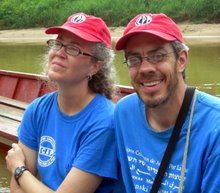
We left Venezuela on October 1 and we are now living in Barrancabermeja, Colombia where we will be volunteering with Christian Peacemaker Teams (CPT) until spring 2007.
Highlights of our month in Venezuela include reconnecting with Nils' host family from when he lived in Venezuela as a high-school exchange student, volunteering at a soup kitchen, and hiking in the Venezuelan Andes. We spent many wonderful evenings with Nils' host family dancing salsa and merengue and eating delicious Venezuelan food. While Michele continued in language school, Nils volunteered full-time at the St. Martin of Porres soup kitchen for the last two weeks of our time in Venezuela. Michele also helped a few times at the soup kitchen and we both gave a presentation to the staff about social work in the United States. We were struck by the similarities in the reasons people rely on soup kitchens in the US and Venezuela, including alcoholism, physical disability, mental illness and aging. One major difference in Venezuela is the lack of government services for people who are poor, including limited services for elderly people, which means they serve many elderly people at the soup kitchen.
During our month in Venezuela we had hoped to get a better understanding of President Hugo Chavez. What we learned is that politics are complicated everywhere, and it's difficult to give a solid stamp of approval or disapproval to most politicians. We were mostly with middle class Venezuelans who tend to be anti-Chavez. People did not hesitate to tell us that life is worse for the middle class under Chavez. Despite this, everyone we heard from predicts that Chavez will win in the December election. The opposition party (Manuel Rosales) says Chavez will win because he will steal the vote, and Chavez's supporters say he will win the election fairly but the opposition will claim election fraud. We heard some concern that Rosales' party will try to overturn the election results by staging protests or strikes when Chavez wins.
As we crossed the border from Venezuela into Colombia we were immediately struck by the increase in security measures. All of the motorcyclists were wearing helmets and vests that displayed their license plate number. Passengers on motorcycles have been responsible for a lot of violence in the armed conflict so there is now a law that motorcyclists must clearly identify themselves to reduce the likelihood that they will commit a crime. We also saw more soldiers and police armed with AK-47s in our first hour in Colombia than we saw in 1 month in Venezuela.
We also recognized upon crossing the border that there are a lot more motorcycles and fewer large cars here in Colombia than there were in Venezuela. Gasoline prices here in Colombia are similar to those in the US, but in Venezuela gas only costs the equivalent of about 18 cents per gallon.
Our first two weeks in Colombia have been very busy. We are settling into our home with the other volunteers, several who have been here for years. The team is comprised of people from the US, Canada and Colombia. Our living situation is very comfortable, with a typical cement and tile home with an open patio. We have a stove, refrigerator and running water. We wash our clothes by hand. The weather is hot! The thermometer in our room has never gone below 80 degrees since we arrived, even at night. Luckily, we have plenty of floor fans and ceiling fans.
We spend our days attending meetings and going out into rural areas where people have been threatened with violence and feel more comfortable with an international presence. For example, we spent one night in a small river community. This is a community that was violently forced off of their land several years ago. CPT was invited to Colombia to assist this community in returning to their land. Currently, a team from CPT takes the two hour canoe ride to the community every week to spend time in the community. Most of the time is spent visiting at people’s homes, but we will also stop to talk to any armed groups in the area to let them know who we are, and to ask them to respect the rights of the local people.
A few months ago CPT was asked by a women’s organization to do a 5-minute presentation about non-violence on their weekly television show. Nils taped a segment this week. He talked (in Spanish!) about examples of non-violence in some of the tactics that have been used in a recent transit strike here in Barrancabermeja.
Overview of CPT: Christian Peacemaker Teams (CPT) arose from a call in 1984 for Christians to devote the same discipline and self-sacrifice to nonviolent peacemaking that armies devote to war. CPT places violence-reduction teams in crisis situations and militarized areas around the world at the invitation of local peace and human rights workers. CPT embraces the vision of unarmed intervention waged by committed peacemakers ready to risk injury and death in bold attempts to transform lethal conflict. Three years ago CPT helped a group of Muslims in Iraq to create Muslim Peacemaker Teams.
You can read more about CPT or make a donation in our name to support our work at www.cpt.org
Overview of the conflict in Colombia: Colombia's current war has been going on for at least 40 years, though many would say much longer. In the early 1960s in a climate of great social and economic inequality, two left-wing guerrilla groups, the FARC and the ELN, were formed, in part by poor farmers struggling for access to land rights. Then in the 1980s, paramilitary groups (privately funded armies) began to form. The paramilitaries oppose the guerrillas, and often work together with the Armed Forces, but they are not an official part of the government's institutions and therefore able to use much more aggressive – often horrifically cruel and violent – tactics in fighting the war. Drug traffickers and large landowners have joined with members of the Armed Forces to train, fund and strengthen the paramilitaries. These right-wing paramilitaries have been responsible for over 70% of human rights violations against civilians. Drug-trafficking has complicated the situation considerably, providing funds to both the paramilitaries and the guerrillas, but drugs did not cause the conflict, and the elimination of drug money is unlikely to end it. The FARC, the ELN, and the paramilitaries are all active in the area around Barrancabermeja.
All these different groups might seem a bit confusing, but in many ways the situation is quite simple, because the casualties in this war are not, primarily, members of any of these armed groups. Instead, most of the victims are civilians caught between them. The guerrillas accuse civilians of collaborating with the army and the paramilitaries, and the army and the paramilitaries accuse civilians of collaborating with the guerrillas. Each year, over 3,000 people die as a result of the conflict. In the last twenty years, over 3 million Colombians have been forcibly displaced - forced to flee their homes, farms, churches and communities – by violence or the threat of violence. The United Nations calls it the worst humanitarian catastrophe in our hemisphere.
As we get settled here in Colombia and learn more about the struggles facing the people we'll be working with, we'll keep updating you. We also look forward to your updates and news from home!
Peace,
Michele and Nils