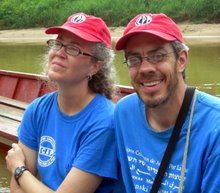
Dear friends and family,

Seasons greetings from Nils and Michele!  We hope
that you have passed a peaceful and joy-filled
holiday season.  As many people celebrate the birth
of the Prince of Peace, we pray for peace in areas
where there is violence around the world, whether
it is Minneapolis, Palestine, the Congo, Iraq, or
here in Colombia.

December was a busy month for us.  Nils and a
teammate spent almost 4 weeks in Nariño province
learning more about the Awá indigenous people and
preparing for a CPT accompaniment there.  We
learned about the Awá history and culture, and
the threats facing their communities.  We visited
a traditional Awá village, which is accessible
by hiking for 8 hours on trails through a
mountainous rainforest.  We had fun getting to
know the kids of the community, who watched us
attentively for hours from the front door of the
house where we stayed.  Some of the children spoke
only Awapit, so we had to communicate through
smiles and gestures.

The Awá are facing serious threats from the
armed conflict, since it is one of the target
areas for Plan Patriota, the U.S. funded military
strategy aimed at rooting out Colombia's guerrilla
armies.  Living in Colombia, one becomes accustomed
to seeing police officers and soldiers carrying
M-16 rifles patrolling commercial districts,
traveling the city streets, and standing at
military control points alongside many roads.
Despite feeling accustomed to seeing the military,
in Nariño I couldn't help but feel overwhelmed by
their presence.  Tanks and armored personnel
carriers lined the sides of the highway in places,
or filled city streets.  The soldiers were rarely
seen far from their armored vehicles. Military
checkpoints in Nariño are a serious affair.
Traveling the main highway, you can be assured that
you will be stopped, probably more than once, to
show your ID, get patted down, and have your
vehicle searched. Combat between the army and the
guerillas has forced many Awá to flee their homes.

The other threat to the Awá way of life is big
development projects.  The Awá have organized
themselves into 37 reservations, many of which are
recognized by the government, but some of which are
still in the process of certification.  Recently
the Colombian administration refused to re-affirm
a UN treaty recognizing the rights of indigenous
people, and in other ways the government has
signaled that they will not grant another acre to
indigenous communities. Instead, the administration
would like to open indigenous land up for mineral
exploration, commercial oil-palm plantations, and
hydroelectric projects, all in the name of "free
trade".

Meanwhile, Michele traveled to the Sur de Bolivar
(the southern part of Bolivar province) where she
met with small farmers whose crops had been damaged
and their health put at risk by the U.S. funded
aerial fumigation of coca crops.  In many cases
the fumigations missed coca crops, and instead
killed food crops, drifted over people's homes, and
contaminated water supplies.  Some farmers in the
area do grow small plots of coca, which is one of
the only crops that pays for itself given the
transportation costs required to get crops to
distant markets over bad roads.  However, the
fumigation programs have not been effective in
reducing the coca production of Colombia, and they
are driving many people off their land as their
legitimate food crops are wiped out.

In the days before Christmas, Michele and a
teammate accompanied people who live in a river
community near Barrancabermeja. There was time
to visit with families we have come to know over
the last few months, play with the new babies,
and help with preparing the traditional Christmas
custard or 'natilla'.  On December 24th a family
invited Michele and Erin to share their Christmas
dinner.  Michele and Erin also had the opportunity
to talk to an army battalion that had coerced two
young men to ferry them across the river in their
boat, in violation of International Humanitarian
Law.  Michele and Erin talked to the soldiers about
their responsibilities under the law, and got them
to agree to let the young men go home.  Their
parents were very relieved to see them return
safely.

We spent Christmas in Barrancabermeja with a few of
our teammates.  The holidays in Colombia can be a
time of increased threat for communities at risk,
so it was important for us to be available in case
an emergency accompaniment request came in.
Fortunately, everything was quiet here.  We had
lunch with teammates and then practiced a few
Christmas Carols in Spanish and visited our
neighbors. Our singing was warmly received and
several people remarked that they had seen
Christmas caroling in movies but had never
experienced it.

Peace be with you,
Nils and Michele

CPT MISSION STATEMENT: Christian Peacemaker Teams
(CPT) Coloimbia is a community made up of trained
volunteers from different cultures that forms part
of the international, ecumenical organization, CPT.
Our work is based in, though not limited to, the
Middle Magdalena region of Colombia. We work
together on grassroots initiatives to expose and
transform structures of domination and oppression
through active nonviolence in order to make
possible a world grounded in respect, justice and
love, even of enemies. Read more at www.cpt.org.